Throughout 2025, I’ve gotten plenty of positive feedback on my writing from very diverse audiences, from engineers and scientists, to founders, CEOs, academics and even non-technical folks. I’m clearly doing something right (it can’t all be just “vibes”). Over the last few days, as I’ve been reflecting on this, I realize that there are a few things I’ve been doing at a subconscious level as I write each of my posts.
In this post, I’ll externalize this thought process into a framework that I hope is useful for other folks like me who are writing technical content. Because so much writing is already being done by LLMs nowadays, I want to focus on what I believe humans can do better (with or without the help of LLMs), and to encourage folks to write more authentically.
Lately, I’ve been lamenting over the degradation in my X and LinkedIn feeds — most posts are video-based slop that caters to the low-attention span crowd, and many long-form written posts are often AI-generated (especially on LinkedIn), lacking depth and substance. So, I hope this post resonates with folks who want to read/write more in 2026 (I know I do)!
It all begins with the way you read#
I firmly believe that the way you read shapes how you write. The example I give below applies mostly to text-based content online, like blogs, essays and papers. When I come across any long-form piece of writing, I tend to subconsciously break down the content into three layers.
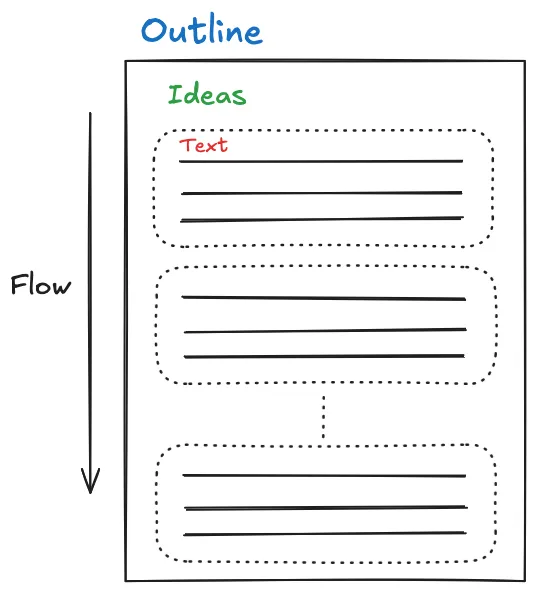
Even though I love reading long-form content, time is often scarce, so I don’t begin by reading the post word-for-word. I always do a first pass where I skim through the entire piece at a very high-level, looking for key takeaways. This is driven by the “outline” layer of the post. The outline gives me an immediate sense of the author’s vision, and why I should care about reading the entire post in detail. If the outline comes across in my mind as haphazard or incoherent, I usually don’t bother coming back.
Once the outline passes my initial filter, I normally come back (when convenient) to read the entire post. In this pass, I tend to focus on the “ideas” that seem interesting, and read those sections more carefully. The ideas are the meat of the post — they lay down the core themes, concepts and arguments the author is trying to convey. If the ideas are too generic or shallow, I usually stop reading further and move on to other things.
Finally, if the ideas resonate with me at a deeper level, I carefully read the entire post word-for-word, paying attention to the “details”. The details include the specific verbiage, anecdotes, data points and references the author uses to elaborate on their ideas. If the post lacks sufficient detail, it can end up feeling “empty” — even though there are very well-written words, there’s no substance behind them, and the reader walks away with no new insights. This is very common in AI-generated content (what people are calling “slop”).
Another way I think about these three layers is in terms of their level of granularity, and how the mind perceives them.
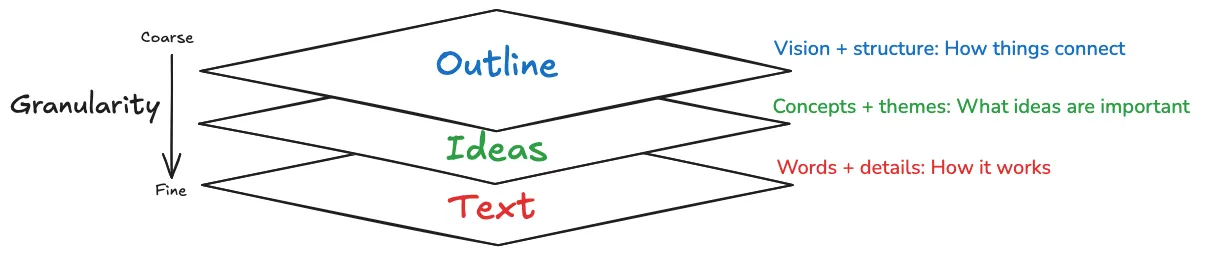
| Layer | Granularity | Focus | Purpose |
|---|---|---|---|
| Outline | coarse | structure, vision | Why should I care? |
| Ideas | medium | concepts, themes | What are the important ideas/themes? |
| Text | fine | examples, anecdotes, data | How does it work? |
While reading, I tend to jump between these layers quite fluidly. Most times, I might skim the outline first, then dive a little deeper to understand the key ideas, then jump back to the outline (all at a subconscious level) which lets me gauge structure and coherence. This relates to the concept of flow in writing.
Good flow isn’t just about linearly presenting ideas from top to bottom — it’s also how smooth the transition is from one idea to the next one. This allows readers to rapidly move between layers with ease as they’re reading, without feeling lost or confused. Flow is what ties in the three layers together, creating a sense of coherence and unity, making the reader walk away feeling like they gained something in the process.
Why LLM-generated text is so dissatisfying#
Shreya Shankar wrote two excellent posts1,2 about why LLM-generated text always seems slightly “off”, sometimes even “uninviting to read”. Ted Chiang’s New Yorker piece3 from earlier this year that likens ChatGPT’s outputs to “blurry JPEGs of the web” also hits home.
The whole point of a blog post, to me, is that a human spent time thinking about something and arrived at conclusions worth sharing.
LLMs don’t inherently care about the topic they’re writing about the way humans do. They take instructions from the prompt and generate text in response. But getting from what humans mean to something the model can act on, through prompting and the way it’s conditioned in the model’s weights, is inherently lossy. This means that the nuances and grounded world-knowledge that humans possess in droves, are completely missed — the LLM fails right at the beginning, at the “outline” layer.
Next, LLMs can very effectively regurgitate common ideas and themes from their “deep research” abilities. Because they can very rapidly retrieve and scan through vast amounts of text, the ideas they generate often feel like a mashup of existing concepts. This means they also fail at the “ideas” layer - when asked to generate ideas to assist in writing, they often produce content where the result feels way too generic, shallow and unoriginal.
It’s only at the bottom layer (“text”) where LLMs might actually fare better than most humans do (for now). LLMs are pretty much perfect at writing grammatically correct text, and can even mimic different writing styles very convincingly. But even at this layer, there are issues — AI-generated text tends to be overly verbose throughout. An LLM generally has poor judgment about when to be concise and when to elaborate. Human-written text, on the other hand, tends to intelligently use repetition and verbosity where needed.
As Shreya aptly notes in her post ⤴:
It’s now cheap to generate medium-quality text—and even high-quality text, when the scope is narrow and well-defined. But figuring out what to say, how to frame it, and when and how to go deep is still the hard part. That’s what takes judgment, and that’s what LLMs can’t do for me (yet).
Because LLMs can’t innately feel what the writer wants to convey at a deep level (it totally depends on the instructions in the prompt) — the ideas end up feeling hollow, the outline disjointed, and the text overly wordy, leading to that now-familiar dissatisfying feeling as you go through it.
How can we write more authentically?#
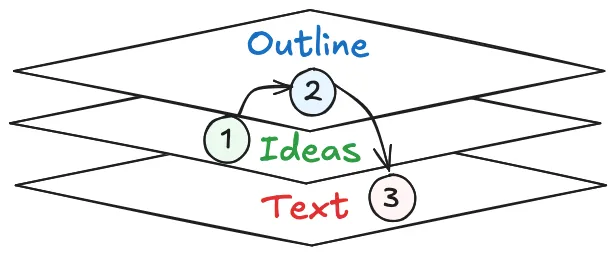
I’ll now share how I apply the above framework to my own writing process, using this very post as an example. It all begins with the ideas, followed by the outline, and finally the details.
-
Ideas first: Everything begins with what ideas I want to convey. For this post, the key ideas revolved around “what do I look for when I read?”, “what is lacking in most AI-generated content?”, and “how can humans write better?”.
-
Outline next: Once I have the ideas clear in my mind, I create a rough outline of the post, writing down the sub-headings and key points I want to cover under each section. The outline essentially emerges from the ideas, so this step rarely takes much effort. As I write, the outline may evolve, with sections being added, removed or rearranged to improve flow.
-
Details last: Finally, I fill in the details for each section, elaborating on the ideas with useful examples, diagrams, anecdotes and references. In this step, I may use LLMs to help me clean up the verbiage of specific sections, but I invariably end up editing the LLM’s work to ensure it doesn’t break the flow.
Put simply, if I don’t have clearly formed ideas that I think are worth sharing, I don’t write anything at all. I tend to keep an “idea graveyard” where I jot down interesting writing ideas as they come to me, but not all of them survive the test of time. I have a ton of ideas in my graveyard that never ended up becoming posts, because the transition from “idea” → “outline” → “details” never felt natural.
Offloading the ideation and outlining process (layers #1 and #2) to the LLM is where I think a lot of LLM-generated content goes wrong. I think it’s okay to use LLMs for #3, to assist with paraphrasing or polishing the text, but for the foreseeable future, and certainly in the coming year, I believe the core ideas and outline for content must come from the human writer — because only humans have genuine attachment to the idea at hand, allowing them to exercise judgment about what to include, what to leave out, and how to lay out the broader vision in a way that’s coherent and interesting.
Conclusions#
There’s something innately beautiful about authentic human writing that causes it to resonate at a deeper level. Good writing expresses the writer’s personality and thought process, and even though I may not have met them, I can often feel a connection to the writer nonetheless. I’d really love for more of us to write this way — from the heart, with genuine ideas, a well-thought-out outline, and rich details that bring those ideas to life.
Using a rough framework like I showed above for reading and writing has worked well for me over the years. This post took ~3 hours to write, all the way from initial ideation to the completion of the first draft. While it’s definitely slower to write this way than just prompting an LLM “write a blog post about X”, I firmly believe that the end result is way more satisfying for both the writer and the reader.
If you’ve made it this far, I’m sure you’ll agree with me on most points! Thanks for reading, and here’s hoping for less AI slop, and more authentic, long-form content for and by humans, in 2026! 🚀
🎄 Oh, and here’s wishing everyone Merry Christmas and happy holidays! 🎄
Footnotes#
-
“Writing in the Age of LLMs” by Shreya Shankar, sh-reya.com/blog ⤴ ↩
-
“On the Consumption of AI-Generated Content at Scale” by Shreya Shankar, sh-reya.com/blog ⤴ ↩
-
“ChatGPT is a Blurry JPEG of the Web” by Ted Chiang, newyorker.com ⤴ ↩